N/A
Credits
N/A
Artists
- Ben Arnold
- Omar Badsha
- Hilda Bernstein
- Willie Bester
- Gerard Bhengu
- Gregoire Boonzaier
- Arthur Butelezi
- Chauke Family
- W.H. Coetzer
- Peter Clarke
- Welcome Danca
- Sibusiso Duma
- Diederick During
- Dumile Feni
- Emily Fern
- Judith Gluckman
- Constance Greaves
- S’Celo Hlongwa
- Jackson Hlungwani
- Gavin Jantjies
- Sfiso Ka-Mkame
- Dorothy Kay
- Job Kekana
- Thomas Kgope
- Eli Kobeli
- Welcome Koboka
- Dezso Koenig
- Vincent Kubeka
- Sydney Kumalo
- Amos Langdown
- Maggie Laubser
- Ezrom Legae
- Simon Lekgetho
- Neville Allan Lewis
- Lippy Lipshitz
- Zan Louw
- Noria Mabasa
- Fikile Magadledla
- Judus Mahlangu
- Zamani Romeo Makhanya
- Trevor Makhoba
- Enos Makhubedu
- Joseph Manana
- Billy Mandindi
- Louis Maqhubela
- Joe Maseko
- Mizream Maseko
- Colbert Mashile
- Johannes Maswanganyi
- Leonard Matsoso
- Azaria Mbatha
- Eric Mbatha
- Gladys Mgudlandlu
- M.T. Mhlongo
- Mbongiseni Jerome Mkhize
- Simon Mnguni
- David Mogano
- John Koenakeefe Mohl
- Nathaniel Mokgosi
- Ernest Mancoba
- Julian Motau
- Tommy Motswai
- Harry Moyaga
- Clifford Mpai
- George Msimang
- Zwelethu Mthethwa
- Myeza Mthokozisi
- John Muafangejo
- Nelson Mukhuba
- Lucy Mullins
- Albert Munyai
- Selby Mvusi
- Sipho Ndebele
- Ephraim Ngatane
- Lindelani Ngwenya
- Sam Nhlengethwa
- Hezekiel Ntuli
- Derrick Nxumalo
- Frederick Hutchinson Page
- George Pemba
- Marianne Podlashuc
- Alexis Preller
- Dan Rakgoathe
- Philip Rikhotso
- Winston Saoli
- Johannes Segogela
- Gerard Sekoto
- Phutuma Seoka
- Cyprian Shilakoe
- Paul Sibisi
- Sithembiso Sibisi
- Durant Sihlali
- Lucas Sithole
- Themba Siwela
- Cecil Skotnes
- Irma Stern
- Alfred Thoba
- Enoch Tshabalala
- Barbara Tyrrell
- Maurice Van Essche
- Mary Van Wyk
- Marjorie Wallace
- Clive Zamani Xaba
- Vuminkosi Zulu
- Tito Zungu
- Manfred Zylla
Mary Van Wyk
University and Technical College Fine Arts departments in South Africa have produced many graduates since they were established at various centres around the country in the first half of the twentieth century. They were, until comparatively recently, mostly exclusively ‘white’ institutions. Of Mary van Wyk we know nothing at present, other than the unverified fact that she was a student under Professor John Oxley (1888–1955) at the University of Natal.
Oxley served as professor at the University’s department in Pietermaritzburg between 1923 and 1952. He had first arrived in South Africa in 1919, bringing with him a sound training obtained at British institutions such as the Leicester School of Art and the Royal College of Art in London. Oxley was above all a committed art educationist, besides his involvement in the Natal Society of Artists and his vice-presidency of the short-lived South African Institute of Art.
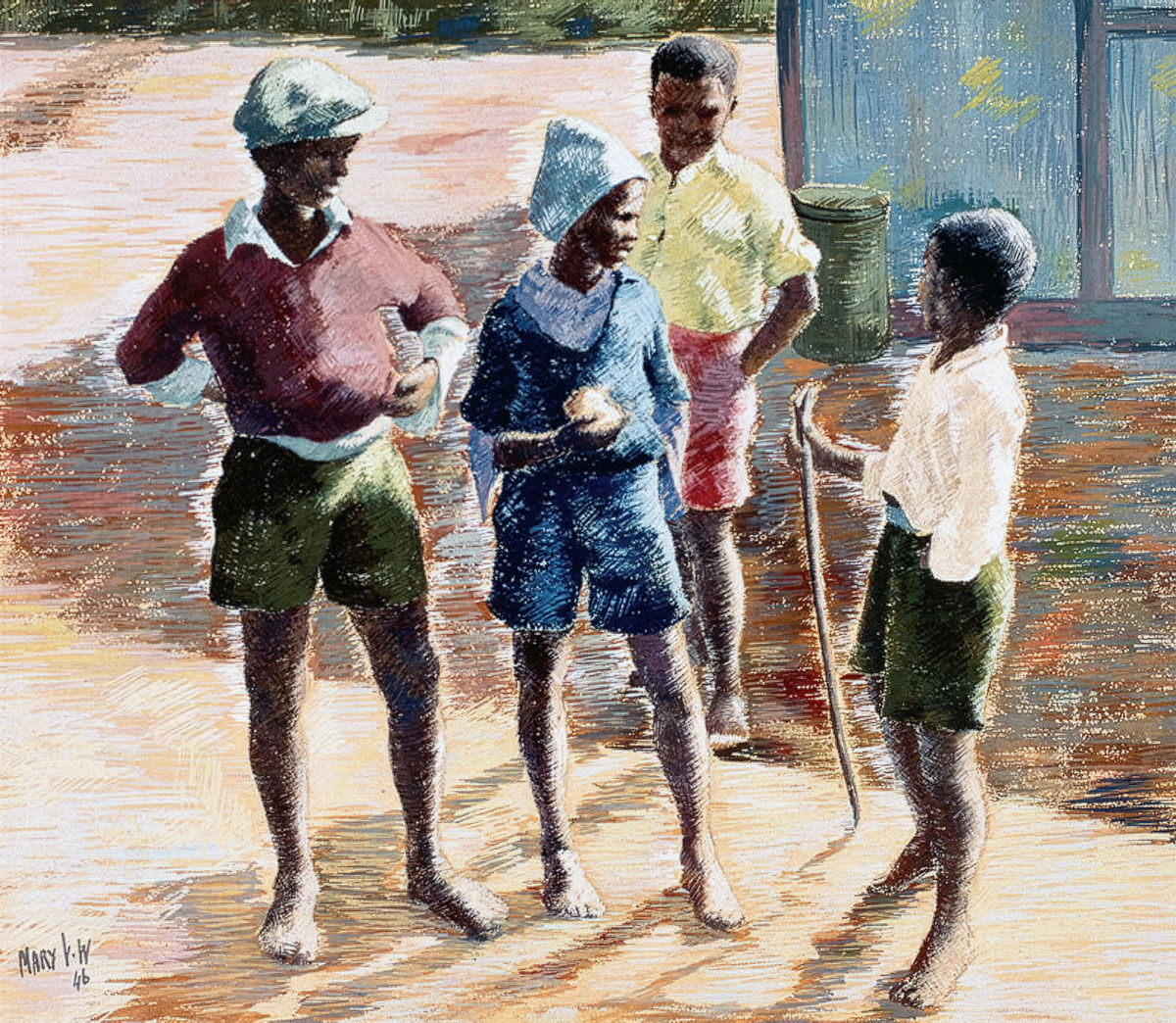
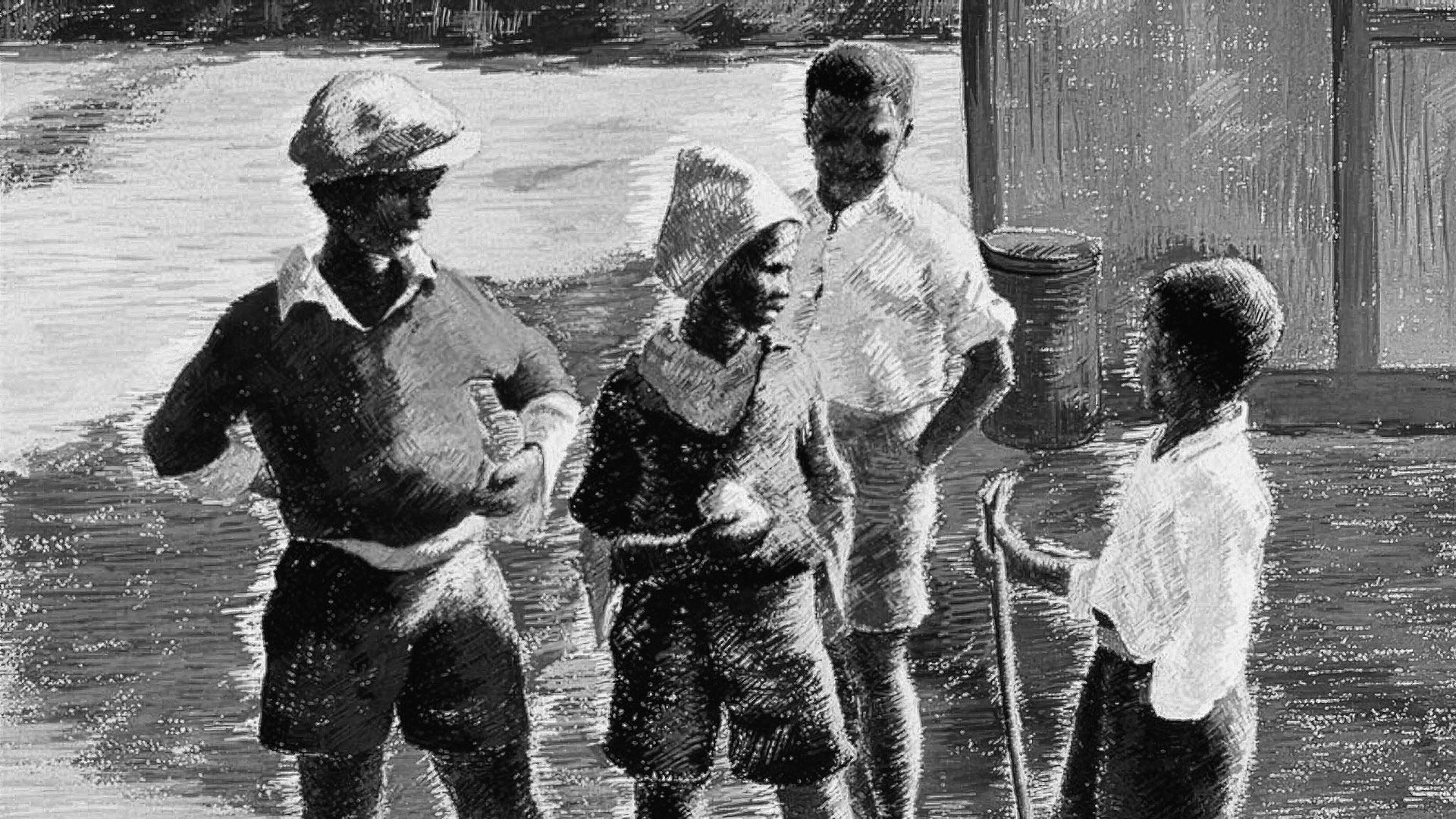
In many ways Oxley represented a British model of art edu- cation, which was solidly academic, somewhat conservative and primarily committed to the development of sound observational skills in drawing and painting. These are all evident in Van Wyk’s Children in the street (1946) (plate 8).
What is unusual about this painting is that, while it represents, to some extent, the ongoing tradition of the ‘native study’,1 it does not ‘exoticise’ its subjects by representing them in traditional dress or locale, but situated within the reality of life in the urban ‘location’. Placed next to a similar work by Gerard Sekoto of the same date, Van Wyk’s Children in the street would still speak, however, of the starkly different worlds of the black and the white artist in South Africa. For all its authenticity of subject, skill and observation, it remains as detached from its subject as Sekoto’s was experienced and deeply felt. Nevertheless, it has a place within the Collection to inform and represent the different realities of South African artists in the colonial era.
Hayden Proud
Citations
- See entry on Constance Greaves, p.16